
Excerpt from The Atlantic:
“The closing of Dupont Circle felt like a bad omen. The park and its namesake neighborhood, a longtime hub of gay life in Washington, D.C., were expected to be packed during World Pride 2025. But on June 2, the National Park Service announced that it would be shutting down the place on the celebration’s culminating weekend.
The intrusion of federal Washington on the District was unsettling but not unprecedented; the circle, like many of the most popular spaces in the city, is not under local control. More unusual was the chaos that followed. For many residents, there was a sense of fear that the federal government was intentionally excluding queer people from a beloved green space. (The NPS later said that the city’s police chief had asked for the closure.) The shutdown order was reversed the next day, then suddenly reinstated. Black security fencing went up on Friday, and then came down again the next morning, opening the circle just in time for the headline parade, on June 7.
The entire affair—the opening, the closing, the paranoia, and then the alarming news of a shooting (which was unrelated and, thankfully, nonfatal)—could be easily put down to the vagaries of big-city life. But it also served as a heavy-handed metaphor for the general vibe of Pride month in the capital and across America: severe emotional whiplash.
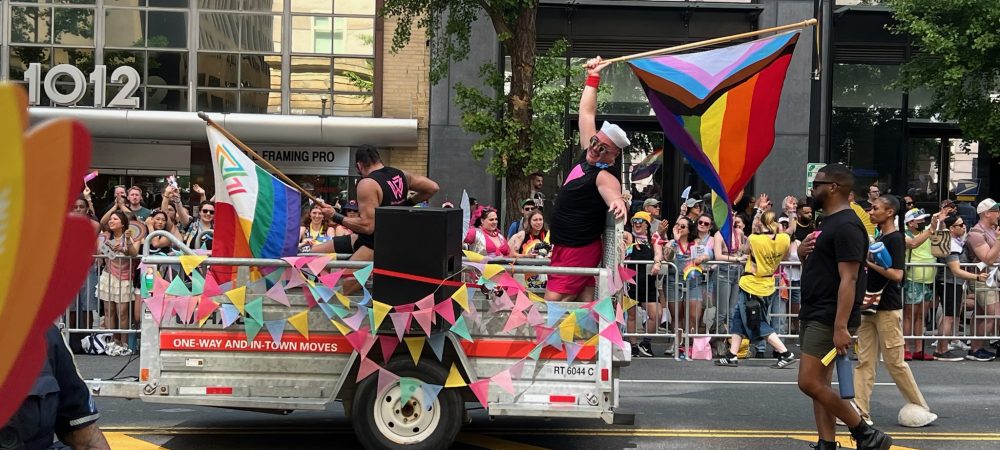
For D.C.’s queer community, this was supposed to be an unambiguously triumphant June, one marking multiple important anniversaries. World Pride, an international LGBTQ festival, had hastily chosen D.C. for its ninth event, after the initial 2025 host, Taiwan, pulled out. The change was fortuitous, in part because it coincided with the 50th anniversary of Pride events in D.C. (first organized in 1975 just a few blocks north of Dupont Circle). And most significantly, this June is the tenth anniversary of the Supreme Court ruling in Obergefell v. Hodges, which legalized same-sex marriage nationwide.
And over the past six months, rescinding rights has become official policy. Trump has targeted individual transgender teenage athletes on social media, while his government has cut funding for HIV research and prevention worldwide. State governments and major religious denominations are challenging same-sex marriage, and corporations with a recent history of unfurling rainbow flags – Booz Allen Hamilton, Mastercard, Pepsi – have pulled out of sponsoring Pride events. The White House called LGBTQ-specific suicide-hotline services “radical grooming contractors” and abruptly halted its partnership with the Trevor Project, a nonprofit focused on preventing self-harm by queer youth.
Now the reality of the moment is setting in, and it’s taking a psychological toll. “I always say people come to a doctor’s office for two reasons: They’re either in pain, or they’re afraid,” Max Doyle, a physician assistant at Whitman-Walker Health, in D.C., who treats many queer Gen Zers and Millennials, told me. “Lately, my patients have been coming in because they’re in mental pain and they’re afraid.” He’s been seeing an increase in depression and anxiety in his patients and referring more of them to psychiatry.
“We’ve been through this before, and it’s really hard on people, but we’re gonna get through this,” Doyle told me. This is what he counsels his patients, based on decades of knowledge about how, for instance, AIDS activists made medications more available and affordable, and trans people shared and used hormones long before they were widely prescribed.”
https://www.theatlantic.com/culture/archive/2025/06/whiplash-pride-month/683315