
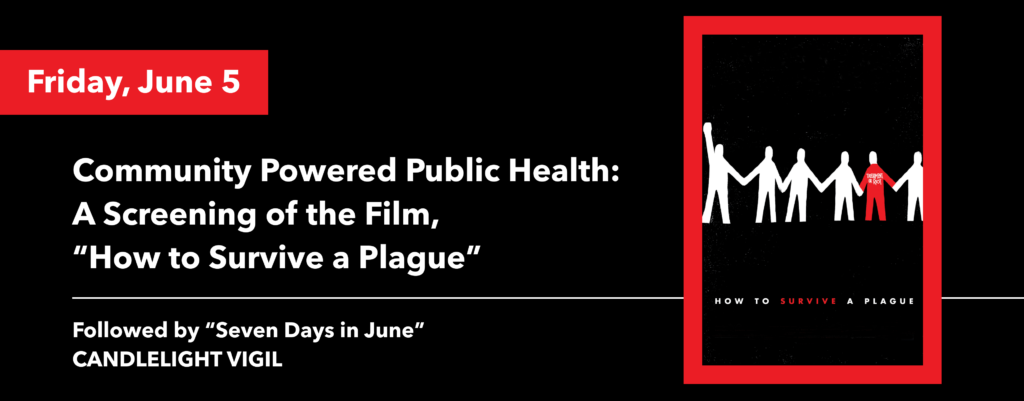
Join us in Commemorating The Crisis: at the Film Screening of “How to Survive a Plague”
On the 45th Anniversary of the First Reported HIV Cases, we honor the lives lost to HIV/AIDS, uplift those living with HIV, reflect on 45 years of resilience, advocacy, and progress, and recommit to the work ahead.
Friday, June 5, 2026 | 5:30 – 7:45 PM
Location: GWU Lisner Auditorium
730 21st St NW, Washington, DC 20052
FREE! Register here
Immediately following the screening of How to Survive a Plague, we will gather at Dupont Circle at approximately 8pm to participate in a “Seven Days in June” Candlelight Vigil.
Brought to you by Whitman-Walker Health, and our partners:




SYNOPSIS
David France’s HOW TO SURVIVE A PLAGUE tells an astounding story of
activism and innovation – about AIDS survival, not death – which has been
overlooked until this timely documentary. Culled from a massive trove of archival
footage, the film is both epic and intimate, tracking a small group of people, most
of them HIV-positive, in their nine-year-long battle to save their own lives. They
end up saving 6,000,000.
It begins in 1987, six years into the epidemic, in Greenwich Village, New York –
the early global epicenter of the epidemic, where half the gay men are already
HIV-positive. On the unfortunate side of that statistic is Peter Staley, an ambitious
young bond trader with boy-next-door looks. Without medications to treat the
infection, he is quickly forced on disability at age 26 and given just 18 months to
live.
Desperate to extend his prognosis – and personally shocked by the indifference
of government and Pharma – Peter joins ACT UP, the history-changing AIDS
activist group. There he aligns with an unlikely ensemble of fiercely intelligent
young men and women: a drama school drop-out, a chain-smoking film archivist,
a New Wave club DJ, a teenager with a GED, an avant-garde video artist, and an
established PR pro among them. None has any medical training. But in their
relentless defiance and will to live, Peter sees his only glimmer of hope.
This is their collective story.